
Ordinary Time
A Memoir -- to be published serially, two segments each month.

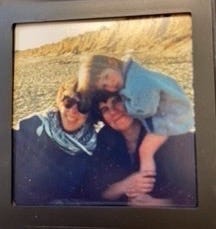
If I were alone in a desert and feeling afraid, I would want a child to be with me. For then my fear would disappear and I would be made strong. —Meister Eckhart
Listen! I will be honest with you,
I do not offer old smooth prizes,
But offer rough new prizes,
These are the days that must
Happen to you.
—Walt Whitman
Chapter 1 - A Twist of Fate
In extraordinary moments, we feel the full power of being alive.
And then quickly after, the fragility of our singular lives.
The let down can be so complete that there is nothing for it but despair. Except now and then, rather than crashing from its heights, there can be a long tail, a bleed of aliveness into the let down. And when that happens, the halo of its bright and burning power can still be felt.
For me, it was during the quiet days following the extraordinary ones I want to tell you about, that I felt a long period of lightness. Just feeling the lightness of being. That we are here so briefly. That we are here, at all.
The headaches started around my daughter’s third birthday. They were mild, fleeting, but frequent, and caused us to consult our pediatrician. That was in August of 1998. The pediatrician examined Brianna’s ears and nose, and asked her to do a series of tasks in order to observe her move her eyes, her tongue, her facial muscles. Based on that exam, our pediatrician concluded that there were no neurological problems. She told us to monitor the headaches, and call if there were any changes.
While the headaches continued, they remained mild and fleeting, and so, unchanged. We took that as a good sign. On an October morning at her nursery school, I watched Brianna as she ran across the floor. My kid is crooked, I thought, seeing Brianna’s head tilted to the left, as if she were listening to something. She did it while running, while standing still. She never stopped doing it. It was subtle. I had to watch her carefully, constantly through her activity, to perceive the tilt.
I asked Sandra, who had been teaching there for eighteen years, with two grown children of her own, “Does Brianna look crooked to you?”
Sandra watched for a moment, then agreed. “Yes. Her head is tilted. I hadn’t noticed that before.”
We returned to the pediatrician. Maura, my partner, had also noticed a subtle change in Brianna’s gait, an uncertainty in her step that had not been there a month ago. Developmentally, she had been getting steadier and more coordinated. This new and occasional falter seemed wrong.
Our pediatrician felt Brianna’s neck and shoulders.
“Are you going trick-or-treating with your mommies?” she asked.
“Yes,” said Brianna.
“What are you going to be for Halloween?”
“A ladybug.” She and Maura had been making the costume all week, Maura’s foot on the peddle of the sewing machine, her long fingers expertly guiding lengths of fabric, Brianna standing at Maura’s elbow, watching, learning.
“The neck and shoulder muscles on the left are definitely tight,” the pediatrician told us. “I think the problem is muscular. Having her head tilted to the side could also throw off her gait. Let’s try hot compresses and gentle massage.”
Maura and I replayed the previous weeks, trying to identify a point of injury. We couldn’t think of anything obvious. Brianna was cautious, not a risk taker when it came to physical play. I remembered one afternoon we spent at a park by the Berkeley marina. There is a ring of boulders at the edge of the park and Brianna and I scrambled on them that afternoon. I held her hands and she hung by her arms while climbing up and down, like a rock climber. We had had a blast, and I fantasized about backpacking trips in years to come. Now I wondered if all that hanging had caused an injury. I relived that afternoon with regret.
We had a full house on Halloween. Maura and I were in our early forties, that busy time of life, with big, overlapping friend groups filling our rambling, two-story Berkeley apartment. We lived with house mates, Lani and Joni. They were not a couple. They were our close friends and chosen family. Lani and I were in the kitchen making dinner, while Joni and Maura glued the last bits onto Brianna’s costume. More friends dropped by. We dished out stew and carried bowls down to the front stoop. While we ate, Brianna passed out treats, thoughtfully eyeing each costume. It was clear from her reactions that to Brianna, some of the creatures visiting us that night were real.
A young bear bounded up our stoop and Brianna stepped back, holding the basket of candy tight against her chest. “You can feed this bear,” I tried to reassure her, but she wasn’t having it. She backed away from the bear until she reached “auntie” Gwen. When the bear finally left, she inched her way onto Gwen’s lap, where she leaned back and relaxed, while Gwen passed out candy, keeping a protective arm around Brianna.
Lani’s cousin arrived with her young son, Dante. He and Brianna made a game of jumping up and down our front steps. Hot from play, they took off parts of their costumes. Brianna removed her ladybug vest and long antennae, and Dante removed his lion paws and furry mane. Someone took a picture of them standing together in the doorway of our home. Dante in his sand-colored fuzzy lion suit. Brianna in her black turtleneck and leggings.
I see the photograph for the first time months later, standing in the hallway at Children’s Hospital. Dante’s disheveled hair, looking straight into the camera, Brianna’s cheek bulging from a lollipop, her skinny black leggings, and dramatic head tilt, all giving the photo a retro, beatnik look. The head tilt was striking in the photo, but I don’t remember noticing it on Halloween night. It was so subtle, not always apparent while watching my child in play, in motion. I sifted through the packet of photos, spanning a month or so of the fall, each photo a frozen moment, capturing the contours of her little body, without the masking effect of movement during free play. In every photo, Brianna’s head was tilted.
There were spells of dizziness and nausea throughout the fall, which our pediatrician treated as ear infection. They seemed more frequent than I thought normal, and I mentioned this to the pediatrician. “Kids get exposed when they start school,” she said. Prior to a weekend getaway with Gwen and her partner, Kay, we made an appointment to be sure there was no current infection. Maura mentioned the head tilt again, and the pediatrician suggested a consultation with a pediatric osteopath who specialized in muscular injuries. In the meantime, as Brianna had no ear infection, we headed up the coast for the weekend.
To be honest, those weekend get-aways exhausted me. I enjoyed being in a new place and watching Brianna take on the big world, but it’s hard work establishing a new routine while keeping constant watch on a young child, in a strange environment with its unknown hazards. I often caught myself in a private reverie, running in the background of whatever else we were doing, in which I was doing it alone. Just living for myself.
Maura and I were different this way. Despite a master’s degree in divinity — and later, a master’s degree in special education — Maura was struggling in her work life. In the white collar, professional world, you have to accept the condition that after a degree and an internship, you’re thrown into the deep end of the pool. Supervisors and mentors can guide you, but you alone face the real-time demands of your work. This didn’t suit Maura, at all. It made her anxious to be in charge when she couldn’t be certain. And professional life is fraught with uncertainty, especially at the beginning; all the moments of doing something for the first time, testing your judgment and ability at every turn, multiple times every work day. Maura was more comfortable as second in command, working as support staff to a superior. But those positions almost always under-utilized her. Maura was bright, quick-thinking, a gifted analyst. In her work life so far, she had withdrawn from professional positions where she felt too anxious and exposed, and struggled in positions for which she was overqualified. As a result, her work life made her feel that she was failing, despite the accolades she always received. Her struggle was internal, and she hadn’t yet sorted it. As a mother, however, she felt, and asserted, her authority. She reveled in family life. It energized her and boosted her confidence. She was a sure-footed mother, relaxed and in charge.
The place where I had relinquished my confidence and authority had been my creative life. By my late twenties, I had figured out how to make a living in theater, but I also knew I couldn’t maintain that life style — on the road for weeks at a time, always hustling for the next gig. Impossible to maintain a primary relationship. I showed promise, and I felt the power and joy of a creative life in which to develop a talent. But what I needed to establish in my young adult life, coming from the chaos of my childhood, was a steady foundation. I needed to regulate myself. As much as I loved theater work, and as hard as it was to give up — I mourned it, for years — I needed to steady myself, even more. I was confident in the world. I moved easily into jobs and responsibilities. All of this came more easily to me than to Maura. But while Maura struggled with confidence in the work world, she was steady in her daily life. She knew how to make a home, how to have good friends, how to cook meals and care for a pet. She knew how to show up every day in a regular home life, as if that were enough. I saw that in her from the start, and it struck me with a kind of longing. This was something I knew I needed to learn.
On Saturday afternoon, I took Brianna to the Mendocino Volunteer Fire Department. One of the volunteers, in his early forties like me, showed us an old horse-drawn pumper that had to be filled and worked by hand. Then he let Brianna climb on a later, engine-driven relic, and encouraged her to ring the large bell mounted on the side. While Brianna turned the steering wheel and bounced in the driver’s seat, I bought a t-shirt and chatted with the firefighter. He told me his story, about coming to this town following a divorce, stepping his way into eleven years of sobriety, how much he enjoyed the work and the brotherhood of the department. As I listened, I imagined moving to Mendocino, volunteering as a firefighter.
As I allowed myself this fantasy of an alternate life, I realized firefighting was not a risk I would take while Brianna was so young and dependent on me. By the time she would be old enough, I’d be in my late-fifties, no longer fit for the job. As I thought these things, a familiar emotion surfaced. Not quite longing, not quite regret. Something unsettled — a reaching out for, a remembering of — an earlier solitary life. My first apartment in the East Village, when I was twenty years old, beholden to no one. A time of poetry and discovery. And promise. Into my mid-twenties, still in New York, enjoying the intense pleasure of collaborative theater work. I was a director, a musician, a stage manager. There were many reasons why I left that life; a web of decisions, each one good, each necessary. And now I was forty-three years old, proud of what I had made in this settled, professional, family-driven version of myself. But I was also acutely aware of its cost, of what I had left behind. The rigors and responsibilities of clinical work had taken almost everything I had to give. And now, raising a young child, I was all in. I had nothing left. I couldn’t find my way back to that internal space where creative impulses incubate to become ideas and then actions. I felt the impulse, but it was frustrated. It had nowhere to go. It became a sense of loss, a shadowy companion to my days, which were busy, routinized, wholly accountable, and densely peopled.
We left the firehouse in search of a playground. Some locals directed us to a small park, but there was only a baseball diamond and a soccer field. I asked Brianna if she wanted to run across the field together. Yes, she said, and took off. She was delighted, lifting her knees up high, looking like a young foal frolicking in the field. I jogged behind her.
Suddenly, she stopped. Her little hands grabbed the back of her head, her back arched, and she screamed. I dropped to my knees in front of her, held her to me, trying to soothe her. Eventually, the tension broke and she leaned into me, exhausted. I held her quietly and then asked what happened. My head, she said.
Up until then, her headaches had been frequent but mild. While she complained, they passed quickly. Not this time. This one was intense. It interrupted her play. It made her cry out. I remained calm and soothing for Brianna, but inside I went numb, fighting panic. It was Saturday night. We were four hours from home. We could get help if we needed it, I told myself. We could call our pediatrician. We could start the drive home to Berkeley immediately. There would be hospitals on the way, if it came to that.
Brianna recovered quickly. She pushed away from me and looked around the field. There was a little hill at the far end. To Brianna it must’ve looked like a mountain. She wanted to climb it. She seemed fine. Whatever it was, it had passed. I walked behind her, helping her with her footing. She was enjoying herself. I forced myself to let her be, to let her feel the thrill of the climb and the accomplishment. At the top, we walked along the ridge, gradually sloping down to the street. Then, suddenly, Brianna looked pale and tired, no longer steady on her feet. She was not well. I picked her up and carried her home. She rested against me.
At the guesthouse, she perked up again, color restored, seeming recovered. She walked into Gwen and Kay’s room, wanting to play with them. I quietly told Maura what had happened. We were scared. The pediatrician had said she was fine the day before, but something was not right.
It was late in the day, and though we were eager to be home, near familiar medical help, we agreed that it didn’t make sense to set out on the long, tortuous drive in the dark. We decided to stay the night and drive home first thing in the morning. Maura and I were unsettled, but we put on a good face, and Gwen and Kay fell in with us. We had dinner at a restaurant. Maura and I were too nervous to eat and picked at our food. Brianna made the rounds, sitting on our laps, enjoying her pasta and broccoli, drawing and listening to adult chatter. On the way back to the guesthouse, Gwen took Brianna into a toy store to choose a stuffy, a gift to celebrate our weekend together.
Maura helped Brianna put on pajamas, while I made a palette on the floor, thick and cozy. Brianna lay down to hear stories.
“My head hurts,” she said, in a small, plaintive voice.
“Where, Boo?”
She touched the back of her head. Then she rolled over onto her side.
“It’s okay,” she said.
“Does it still hurt, Brianna?”
“No.”
Once again, mild and fleeting. We both stayed while Maura read. Brianna was starting to drift off to sleep when suddenly she vomited. We pulled her upright to keep her from choking. She threw up everything in quick, violent spasms. She cried, startled and upset.
We slipped into teamwork. Maura held and comforted Brianna while I folded up the soiled quilt and carried it to the bathroom. I brought back washcloths to clean Brianna and got fresh pajamas. Once Brianna was changed, we settled her in our bed. Maura got a toothbrush and water for Brianna to freshen her mouth. I finished cleaning up the room and rinsing the quilt. We worked in concert, Maura and I, anticipating next moves on instinct. The silence between us was partly attunement, a shared focus on the emergency, but also a desperate hold on mastery as a way to tamp down fear. As Brianna lay down, she whimpered that her head hurt, but then quickly rolled over on her side, the pain having subsided.
All fall, on the pediatrician’s advice, we had taken vomiting as a sign of ear infection. But her ears were fine according to the doctor the previous morning. Could an infection have flared up so quickly? We wondered if she ate too much at dinner. Maybe we didn’t realize we were coaxing to eat too much? Maybe the food was bad? Too rich? We wondered if we would also get sick. We even began to imagine feeling ill. Something was wrong, and we didn’t know what. Twice more she whimpered, woke to say her head hurt, and then quickly went back to sleep. Maura and I settled on the bed, with Brianna between us.
The next morning was chilly and overcast. Brianna woke early and wanted to go outside. We dressed while Maura packed the car and set out for a walk, but soon Brianna looked pale and tired. She asked if I would carry her, and I did. She lay over my shoulder, as if sleeping. She was small for her age, and as I held her close, my hand covering most of her back, her head heavy on my shoulder, I could feel in my body all the hours of holding her, her warmth, the contours of her body, like appendages of my own, all a part of me, now. I held her close all the way back to the cottage.
The drive home was uneventful. Brianna seemed fine, and remained so throughout the day, which added to our confusion. Were we over-reacting? But there was that incident running across the soccer field in Mendocino. After Brianna was asleep for the night, Maura and I looked up headaches again in one of our parent-oriented medical books. Organized by symptom, it started with a presenting symptom, followed by a decision tree through likely symptom clusters, followed by a provisional diagnosis and a recommended course of action. The last cluster of symptoms in the category of headaches read: Severe headache — increasingly frequent — worse upon lying down or waking — headache awakening child — clumsy or walking oddly — vomiting. Provisional diagnosis: Brain tumor.
In the morning, Maura called the pediatrician for an emergency appointment while I called clients to cancel our morning psychotherapy sessions. At the doctor’s office, I stayed with Brianna in the waiting room while Maura went in with the medical book to talk to the pediatrician. Until we had something specific and definite to say, we wanted to protect Brianna from unnecessary anxiety. When I eventually brought Brianna into the exam room, Maura was standing with her back to us. As she turned, I could tell by the warmth with which she greeted Brianna, and the way she avoided making eye contact with me, that she had been in tears moments before. Our pediatrician examined Brianna who, except for the head tilt, seemed fine. The neurological exam was unremarkable. The pediatrician decided to consult with a neurologist, just to be safe.
We returned home. A few hours later the pediatrician called to say the neurologist recommended an MRI. She framed it as a precaution, to rule out a tumor, and said that based on the clinical exam, Brianna’s problem was most likely muscular. I wanted to believe her.
to be continued…
Thank you for sharing your life stories, experience & truths Patty. I miss Maura’s laugh & life on Albemarle Street.
Patty, Thank You for sharing this time in your life, and giving me a more clear idea of what You and Briana have gone through, and letting me know more about Maura, who I was fond of.